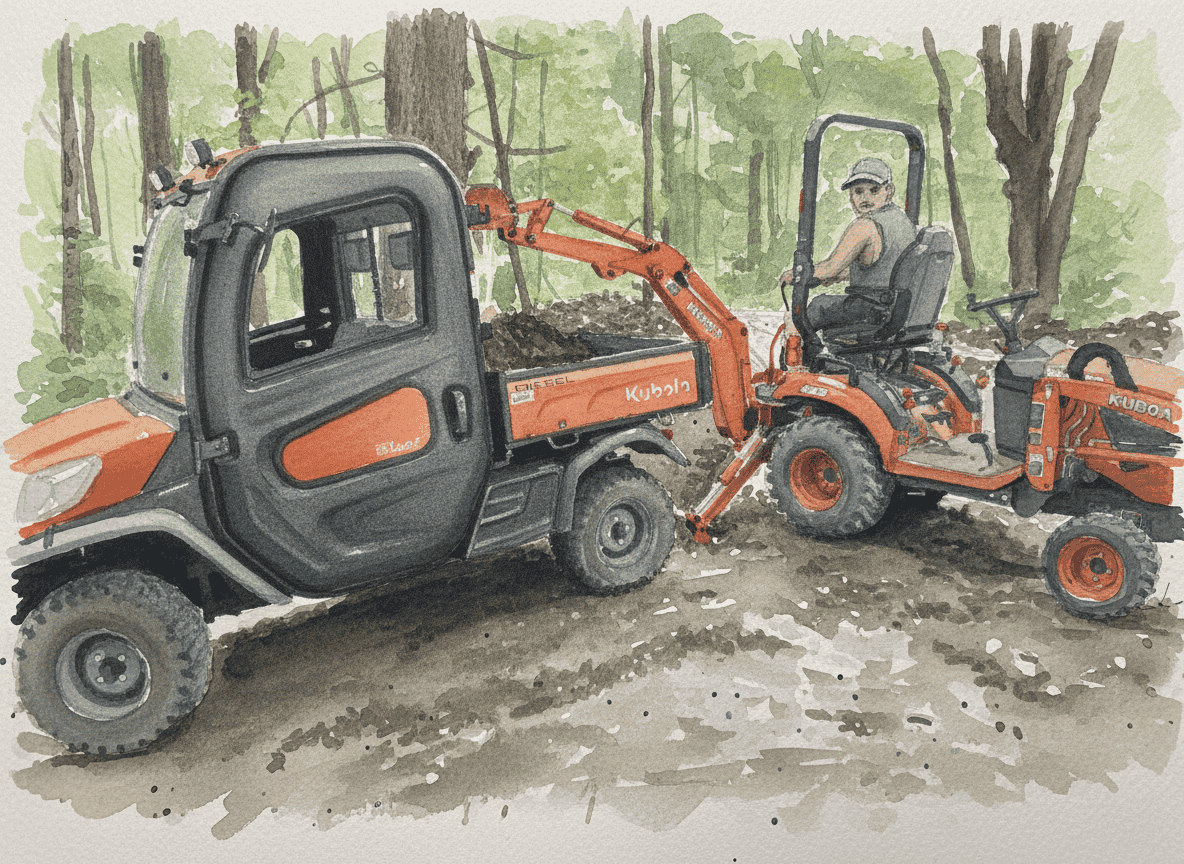
Not long after we bought the land, it became clear that walking everything in by hand was not going to scale especially as we moved to bring in dump trucks of dirt and gravel.
Most of the time, materials could only be delivered to the edge of the property. From there, we had a few hundred meters of dirt road and hills to get gravel, dirt, and sand into the build site.
We needed a reliable way to move large quantities of material efficiently. We could have done everything with the tractor, or improvised other solutions, but it would have taken an enormous amount of time and energy.
At this point, after seeing how much the tractor had helped, we strongly believed in paying (a reasonable amount of) money to save time, especially when our time on the property was limited. If we were going to make meaningful progress, we needed something that could leverage that short time we had.
That led us to look at an RTV (recreational terrain vehicle). These machines are workhorses. They are capable of hauling heavy loads, navigating rough terrain, and being useful year round. Just as importantly, it would complement the tractor rather than replace it.
Since we already owned a Kubota BX23S, it made sense to stay within the Kubota lineup. After looking through their RTVs, one model stood out. The Kubota X1100C included a fully enclosed cab with heating and air conditioning, which is not a luxury in a Canadian winter, and it could be configured with a snow plow. It felt like a machine designed for exactly the kind of work we were doing.
We placed the order and then waited.
This was during a period when supply chains were still heavily impacted by COVID, so delivery took somewhere between 6 and 9 months. When it finally arrived, it immediately went to work.
With the hydraulic dump bed, we were able to move thousands of pounds of dirt more efficiently. Our workflow became simple and effective. The tractor stayed at the road, loading the RTV with 2 or 3 scoops from the front loader, and then the RTV would ferry the material into the property. There was no constant repositioning, no exhaustion from manual hauling, and way less wasted effort.
That single change drastically reduced the time and energy required for the project. We could get real work done without being completely wiped out part way through.
Since then, the RTV has continued to earn its keep. We use it for snow removal, transporting building materials, and hauling camping gear from the road into the property. The machine has an impressive amount of capability. The narrow body, tight turning radius, 4-wheel drive, front winch, and enclosed cab make it particularly well suited to forested land.
Our only ongoing issue has been mice. They seem to find the RTV particularly inviting and can crawl inside to build nests, sometimes over a single weekend. We have been working to block access points and seal openings around the HVAC system.
This is really my only criticism of Kubota here. For machines that are so commonly used in rural and wooded environments, better protection against rodents should have been considered. Simple mesh grates over key openings would have gone a long way.
We’d buy it again. It wasn’t a cheap machine by any means, but we’ve been able to accomplish so much more because of it.