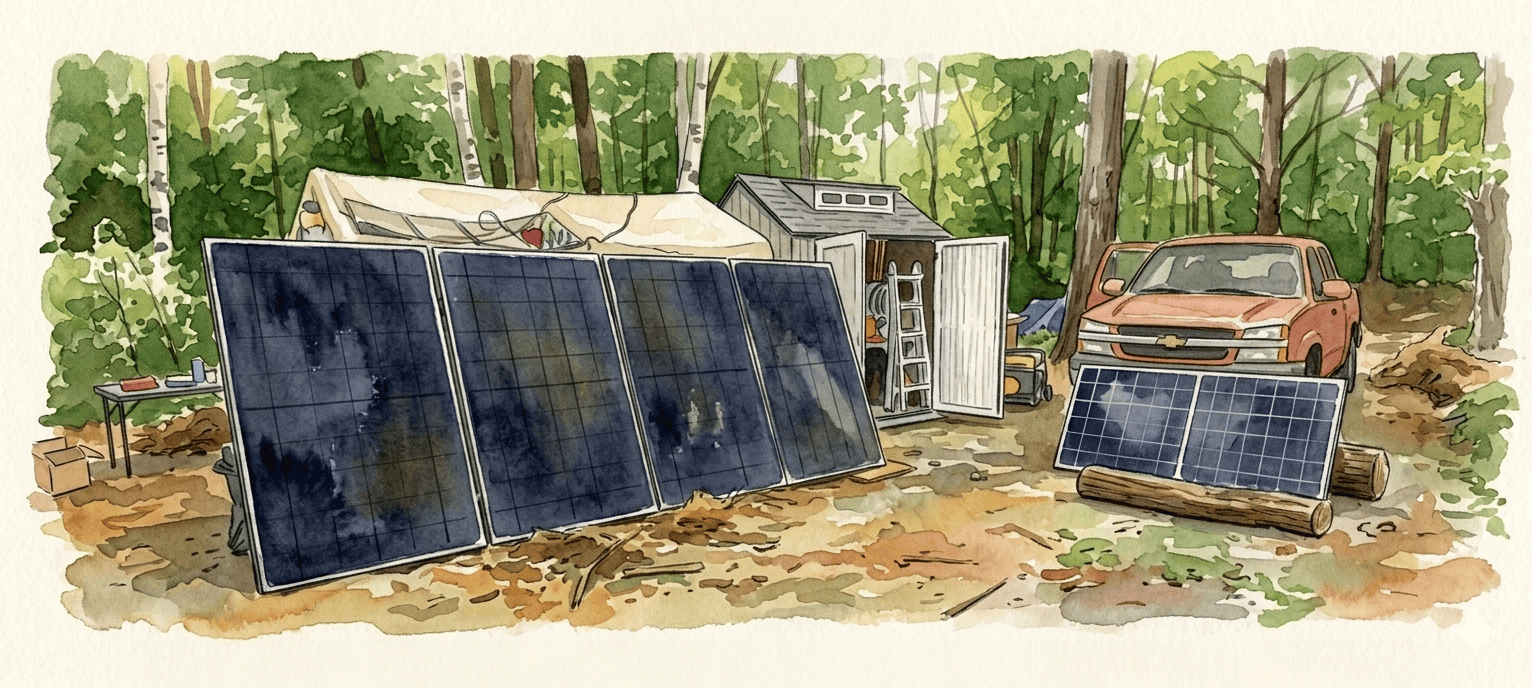
For the first while after we bought the property, we had no electricity on site. We ran battery-powered lights, charged phones off battery packs when we could, and trickle-charged here and there. In practice we were camping on our own land every weekend, and for a time that was enough.
When we did need real power (for tools, charging, or the odd convenience), we had to run a generator. That was when the trade-offs became impossible to ignore. Generators also bring real safety concerns, which we knew well as we’d already had one catch fire overnight in our winter setup.
The generator was loud. One of the reasons we’d bought the land was for peace and quiet: no traffic, no city hum, just the forest. Firing up the generator meant throwing that away for the whole stretch we had it on. It was also expensive. It needed premium fuel, and we were burning through $30-40 in gas per day whenever we used it. For a place we visited on weekends, that math didn’t work. We needed something that could give us power without the noise and the ongoing cost.
Weighing the Options
We started looking at solar. Portable kits, small off-the-shelf systems, and more serious setups. We priced out something that would get us through the next couple of years for a few thousand dollars. Then we looked at what it would cost to build something that would last 10 or 20 years. The gap wasn’t as big as we’d assumed. If we were going to invest at all, it made more sense to invest in something we wouldn’t have to replace in a few seasons.
There were packaged systems on the market: a few batteries, some panels, and a basic inverter, all in one box. For the price, they didn’t feel right. We wanted something that wasn’t a fire hazard (due to lead acid batteries), that would last, and that we could understand and maintain. So we went a different route.
What We Chose
We put together a Victron-based system with lithium iron phosphate (LiFePO4) batteries. We bought a single 400 W solar panel, a Victron charge controller and inverter, and a couple of BattleBorn self-heating LiFePO4 batteries, and wired it all up as a 24 V system.
It was a big step. We’d never built or lived with a system like this before. We took it slowly and learned as we went, though in hindsight we probably moved a bit faster than we should have. There was a lot we didn’t know.
A good example: about 2 years after the original install, we wanted to add more panels. We went looking for the same model as our first one. It wasn’t available anymore. The new panels on the market had a different cell count: our original was 72 cells, and the ones we could get were 66. You can mix them, but the 72-cell panel would effectively lose the output of those 6 extra cells when tied to the same string. So we ended up with a separate charge controller for the original panel and 4 new panels on their own. Not a disaster, but a lesson in how quickly product lines change and how much the details, like cell count, matter.
How It’s Worked Out
Since the system went in, it’s done what we needed. We run Starlink, cheap projectors for late night movies, and tools. We charge phones, pump water from the well, and run lighting without firing up the generator. We can work and relax on the property without that constant background noise. For most of the year it has made a real difference.
Winter is the exception. Short days and snow on the panels mean we don’t get the same harvest, and we’re still learning how to live within that. Even so, we don’t regret the decision. If we were doing it again from scratch, we might choose a different setup, but we’d still be going solar.
Where Things Stand Now
We put this system together in 2022.
In 2026, the landscape has shifted. We’ve repriced equivalent gear and it’s roughly half what we paid. The technology has improved: panels are more efficient, batteries are larger and more affordable, and all-in-one units (the kind that pack everything but the panels into a single package) are becoming realistic options for people who don’t want to piece everything together. Salt-based batteries are starting to show up too. The future for small-scale solar looks promising, and we’re curious to see what we might add or upgrade as the property and our needs evolve.
As we move towards a larger cabin build, we’re looking to expand our system and we might actually separate them entirely. We’ll keep the old system for stuff like water and heating the pipes while we take the new system and apply what we learned to build something more efficient for the core property use.
Solar has certainly become one of our leading interests, something we talk about to no end. We’ve spent a lot of time discussing this with friends in business classes focused on solar, other off-grid enthusiasts, and anyone that will listen.
We’re keen to see what we can accomplish with solar on the property in the years ahead.